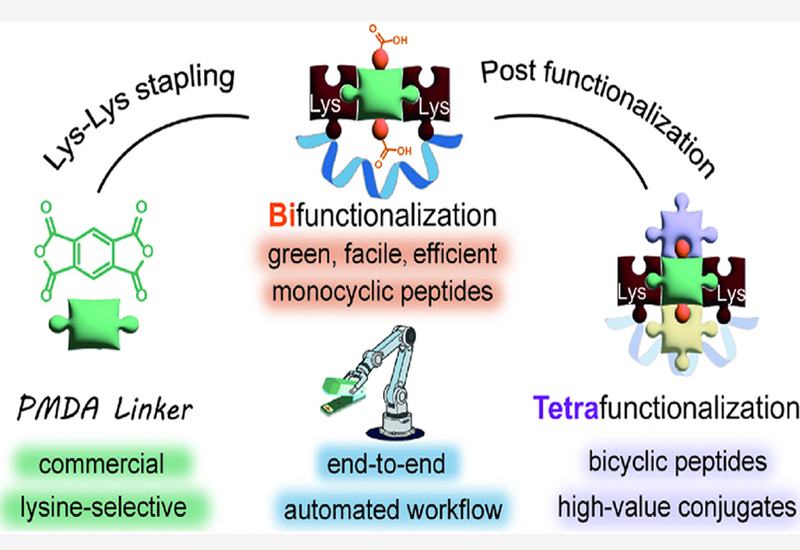
Lys-Lys peptide stapling holds appeal precisely because lysine is abundant, its ε-amine is nucleophilic, and it presents a geometry well suited to intramolecular cyclization. Yet assembling a stapling linker that is simultaneously chemoselective across all other nucleophilic side chains, modular enough to support downstream conjugation, and compatible with automated solid-phase workflows has proved difficult. Existing approaches often rely on noncanonical amino acids with orthogonal reactive handles, cysteine-directed crosslinkers, or transition-metal-catalyzed arylation. While these strategies are powerful, they can add synthetic complexity, constrain residue selection, or complicate integration with automated solid-phase workflows. The result is a persistent gap between the conceptual appeal of Lys-Lys stapling and its practical accessibility in programmable peptide assembly.
Researchers in the Zhang and Li Groups at Zhejiang University, published in J. Am. Chem. Soc., recognized that pyromellitic dianhydride, PMDA, a reagent long used to build aerospace-grade polyimides, could be redirected toward peptide macrocyclization. The strategy exploits the spatial proximity and flexibility of two lysine ε-amines to favor intramolecular bis-amidation with PMDA over competing intermolecular reactions. Unlike conventional bifunctional staples, PMDA is tetrafunctional: both anhydride groups open to form amide bonds with the two lysine ε-amines, closing the macrocycle, while the remaining two carboxylate groups are preserved as handles for further functionalization.