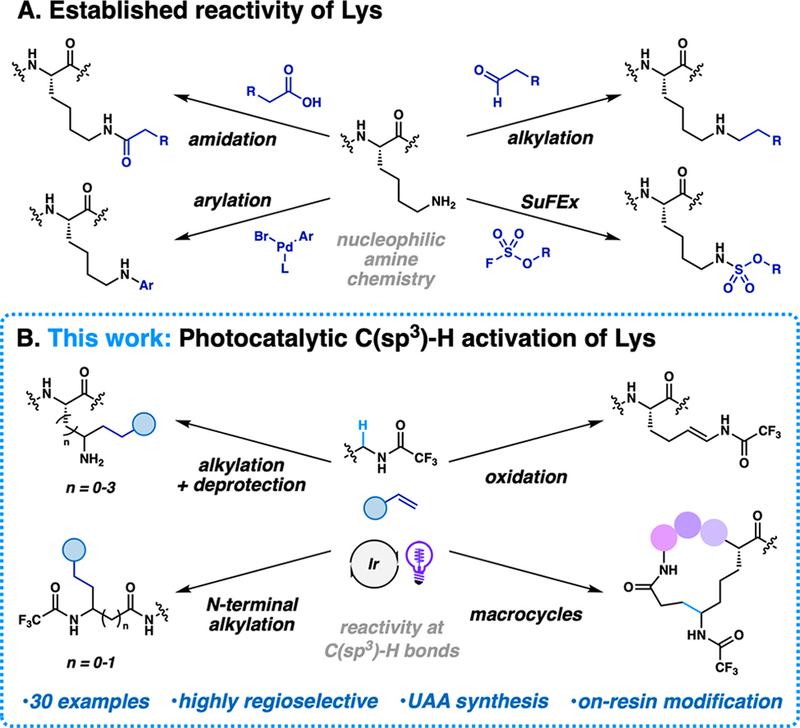
Lysine is one of the most chemically versatile residues in a peptide chain, yet that versatility has a hard boundary: the aliphatic C(sp³)–H bonds of its side chain have remained stubbornly inert to selective functionalization. Existing methods exploit the ε-amino group's nucleophilicity for amidation, reductive amination, and arylation, but forming C–C bonds directly at the β, γ, δ, or ε carbons requires engaging high-energy, electronically unbiased bonds in the presence of a nitrogen atom that readily hijacks radical and ionic reactivity alike. The conformational freedom of the lysine side chain compounds the problem by raising the entropic cost of any transition state that demands a specific geometry. Without a solution, a broad class of branched peptidomimetic motifs remains inaccessible by divergent late-stage editing.
Researchers in the Arora Group at New York University, published in J. Am. Chem. Soc., reasoned that masking the ε-amine with an electron-deficient trifluoroacetamide protecting group would suppress nucleophilic reactivity and simultaneously provide a redox-active handle for radical generation under visible-light photoredox conditions. The amide anion formed under mild basic conditions undergoes single-electron oxidation by an excited iridium photocatalyst to generate an amidyl radical. Crucially, the anticipated 1,5-hydrogen atom transfer to the β-carbon does not compete: conformational constraints appear to raise the entropic cost of the required six-membered transition state, redirecting reactivity toward α-amino radical formation at the ε-carbon via a 1,2-radical shift. That nucleophilic α-amino radical then adds to electron-deficient olefins in a Giese-type reaction, forging a new C–C bond at the ε-position with complete monoalkylation selectivity. The trifluoroacetamide group survives Fmoc solid-phase peptide synthesis conditions and is removable under mild base, making the sequence compatible with on-resin workflows.
By recasting a protecting group as a programmable radical precursor, this work adds a new mode of reactivity to the peptide chemist's toolkit: site-selective C(sp³)–H functionalization at primary amine side chains under conditions compatible with the full Fmoc SPPS ecosystem. The ability to generate branched unnatural amino acid motifs directly on assembled sequences, and to close macrocycles in the same transformation, opens practical routes to architectures that previously required de novo synthesis of exotic building blocks. Mechanistic probes, substrate scope, and on-resin yields are reported in the original publication.